The Social Media SUCKS Show w/ Digital Strategist Scott Monty - Social Media Marketing 2016
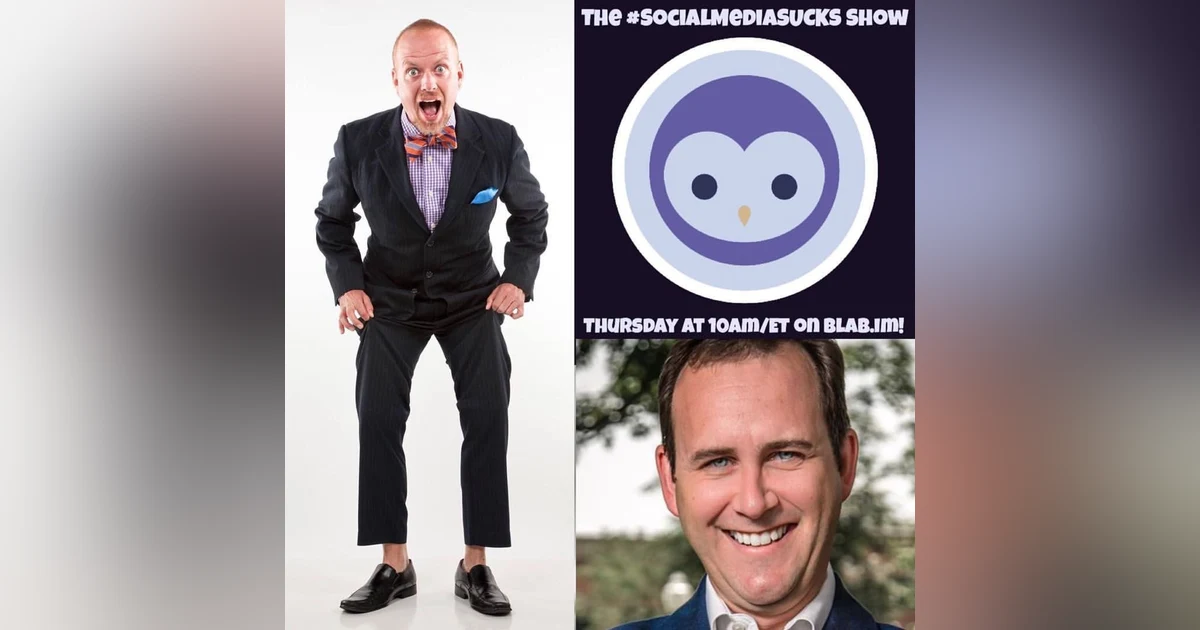

a http://SocialBuzzONAIR.comI've got my bow tie brother, Scott Monty on the show w/ me! We're recapped Scott's journey w/ digital agencies, to working for large brands like Ford Motor Company and SHIFT Communications to launching Scott Monty Strategies! See acast.com/privacy for privacy and opt-out information.

 Apple Podcasts

 iHeartRadio

 Spotify

 Amazon Music

 Audible

 Castbox

 Deezer
a http://SocialBuzzONAIR.comI've got my bow tie brother, Scott Monty on the show w/ me! We're recapped Scott's journey w/ digital agencies, to working for large brands like Ford Motor Company and SHIFT Communications to launching Scott Monty Strategies!
See acast.com/privacy for privacy and opt-out information.
What is happening, everybody? Welcome to the social media sucks show. I'm your host, Sebastian Rusk. As always, hey, welcome to the show. My guest this week and uh trusty co-host, we've got a couple shows this week, my buddy Scott Monty. I believe he is that way, if we're if we look at it correctly, that way here. Scott and I met a few years back at the very um information-driven and entertaining Social Fresh Conference, um, where I believe um that was during your time uh with Ford Motor Company, and we quickly hit it off. Clearly, with the bow ties, we had something to talk about here, and it's been fun to follow your journey. I think that was probably 2013, maybe. That sounds about right. Yep. Yeah so it's been it's it's been fun to uh uh to follow your travels through Ford and over to Shift and now um rocking and rolling um with this the Scott Monty Empire. So uh t tell us all about that. Let let's let's back up a little bit. Um you got out of school. Uh did you go right into the into the into the marketing and advertising world?
SPEAKER_00Well, you know, I uh went from undergraduate to uh get my master's in medical science concurrently with my MBA in healthcare management. So my uh whole idea was to become a double threat to the medical industry. Um this is back when managed care was still in upheaval. I mean, look, we still aren't too far away from that today. But I figured, you know what, um the the administration side of medicine was going to need more people with um scientific knowledge, with medical knowledge, rather than just these cold-hearted administrators. So that was the play there. Um after working for about three years in managed care, that was that novelty wore off, let me just say. And uh from there I went into biotech and pharmaceutical consulting. Um, and that was right around a dot-com and uh the September 11th uh bust. And after that, I went to work for an advertising agency that specialized in healthcare and high-tech. And the high-tech angle is how I started getting interested in um you know more of this up-and-coming uh social media stuff as it was uh becoming known. And uh just started writing about it, interacting with people about it, being becoming really curious. And eventually I left that agency, went to work for a consultancy called Crayon that did nothing but social media strategy for big brands. And then Ford heard about me and scooped me up, and the rest is history.
SPEAKER_03It really is history because, you know, and correct me if I'm wrong, you were you were really one of the initial pioneers to jump on board um on the on the sea level with a large brand and sp within a specific market like the auto industry and bring them social. Let's talk about that for a minute.
SPEAKER_00Well, you know, I wasn't the first. Uh, I probably became one of the most well-known. Um that's the word I was looking for. My friend Chris Barger, who I had known from his time at uh IBM, where he was the chief blogger over there. Uh he had taken up the mantle at General Motors um shortly before I got to Ford. And I had called him up and asked him for some advice and counsel, um, you know, kind of bringing me through it. Uh and he he's a wonderful colleague. Uh he moved on from GM about two years before I moved on from Ford. Uh he's with Voce Communications now. But uh what we what we did is we always had kind of a friendly rivalry in public. But GM's social strategy up until that point was very different than uh what we determined Ford's to be. Um GM was all about corporate blogging and you know the the standard fare that you that you knew then. When I came into Ford, uh we were at a crisis point and we didn't really have a lot of time to reflect. And I had my own accounts on Twitter and Facebook and and the like, and I just leveraged my personal accounts because that's what I knew how to do, and that's where there were other people that I was already interacting with. It's where people were following me already. And as we as we began to get through the crisis and to think about our strategy with a little more um uh level-headedness, shall we say, um we thought, well, look, Ford Motor Company is synonymous with Henry Ford. I mean, his name is still on the logo today. And he was he was with the company for 40 years, its first 40 years. He's one of these iconic businessmen like Steve Jobs or uh Thomas Edison, right? Um and we thought, well, the company itself has been humanized all of these years, why don't we continue the humanization strategy on social media and put our people out there? Um and and that's what I what I led for a good six years.
SPEAKER_03And you know, the I and I think I've heard you talk about this in the past, um, just an incredible relationship with um with American Idol. Um, you know, during your time there, you got a chance to meet my remote mentor and somebody that I look up to um in a in a in a ridiculous way, uh, Mr. Ryan, very talented, Mr. Ryan Seacrest. Um that that must have been fun because not only are you already working with a large brand, um, not only are you a really big deal because you're one of the most well-known individuals doing what you do there, but then you get a chance to work with one of the most popular shows ever and also a major network. What was that like?
SPEAKER_00Well, that was interesting because what it allowed us to do um every I don't know, I don't remember what night it was on back then, maybe Wednesday night, um, I would pop onto Twitter. And remember, this is when Twitter was a much different place. You know, we're talking about nine and and ten or so, um, and just see what people were saying about our commercials and our show integration. Um, you know, Ford, I I love the Mustang. Ford, your commercials suck, you know, whatever it is, right? And we would just take it all in. And occasionally we would reply back, um, either as the as the corporate entity or even me individually, but usually as as the Ford account. And people would get freaked out, right? That this company was like there there were there were like two reactions. One was, um, whoa, this is creepy, right? Which, hey, genius, you're on a public platform, what do you expect? Right. Um, or two, how cool is that that a company took the time to listen to me and responded to my concerns or uh my love for the brand or whatever it is, and it endeared them to Ford. Now, it didn't necessarily mean they were gonna go out and buy a car tomorrow, but it started changing the perception of the brand, which was really our our corporate mission was to improve Ford's reputation and to help build purchase consideration, right? So every little thing we did in in instances like that, whether it was a major execution like American Idol or a single interaction on Twitter, was that.
SPEAKER_03Okay, I I actually locked my screen on accident. I'm like, no, don't go anywhere, Black. So no, I and I followed that. And the the thing that that really caught my eye above and beyond, obviously, it being very um obvious that there's a there's a strong there's a strong relationship between still is, I think, with with Ford and American Idol. In fact, I think I was just watching the final season, so and I haven't watched every season, but ever since I started, probably six years ago, with the whole social buzz thing and deciding that I am in fact going to be on television someday, somehow, somewhere, I started to just follow uh Ryan Seacrest's every move because the guy, not only is he just the new Dick Clark and you know, the new King of Hollywood essentially, just replacing the greats, he's just good. Um there's never any dirt around him. It's just a he's got a solid, profitable brand brand under Bill. I think he's reeling in close to 80 or 90 million a year, um, just as is so. I started to uh I I follow him and I watch the show because of that. And of course, you get reeled in, etc. Um, but the the the Ford integration part of it is so natural because it's kind of a I think it's a music video that integrates, I guess, the idols that are into the process. But I thought, well, what a very natural integration. There's no real buy a Ford, buy a Ford, buy a Ford. It's more like if you're a fan of American Idol, then that's kind of it all in the big conglomerate there. So I thought that was neat. And that must have been a lot of fun to be able to. I saw that picture and I'm like, so I'm one step closer to meeting secrets. Scott Monty met him. He's a little guy, huh?
SPEAKER_00Yeah, he is. He's he's uh not that tall. Um what always struck me about the brand integrations in American Idol, and and feel free to disagree with me. Um the the three major brands from uh the early early days, uh, and and I haven't watched it in a few years, so pardon me if I'm not up to speed, but it was always Coca-Cola, America uh ATT, and uh Ford. Sure. Um three iconic American brands through and through, right? So American, American Idol, obviously it makes a connection. Coke was easy because you had the cups on the desk when the judges were doing their thing, and they always cut away to the scene of the judges, and there's there's coke glasses there or coke cups, fine, ATT. That was essential in the earlier days because they were providing the data plans to call in and you know, texture, a product integration there. Ford to me always seemed the the odd man out, a little bit different than the others. You know, one of these kids is not like the other. Um because what are you gonna do with a car on a on a music show? But the way Ford actually inserted themselves to enable the performers to do their thing, right? And and wove themselves into the fabric of the video rather than it being all about Ford, you know, like you just said, um, I thought that was really, really artful. And and that kind of integration went on to inform other things that we did at Ford uh during my time there, where it wasn't about it wasn't all about the brand. Right. And I think in in this day and age, a lot of people get turned off by the brands that are like, hey, look at us, look at us, pay attention to us, retweet us, look at our stuff. Versus taking the time to put the customer front and center. And if you know, if you're if you're talking about, say, storytelling, for example, uh, the hero of the story is not the brand. The hero of the story should be the customer, right? The brand is a minor character in the story that hopefully enables the customer to do whatever it is that they need to do. Sure. It's not all about the brand.
SPEAKER_03Well, the the initial thing, you're you're exactly right. And I and I I can totally see that they where where you're coming from pertaining to that. What I always thought of when I see, and I still do. In fact, I watched the show last week, or I've got a DVR and I watch it whenever I get a chance to, but um, it's always like, oh, that's what the idols are up to, you know, during the week. You know, in between in between shows. I mean, it kind of gave that, and I think that was probably some of the angle, because you're right. What are we gonna do? Have Seacrest drive a fiesta out on stage?
SPEAKER_00I mean, that's about his size.
SPEAKER_03This is true. Yeah, I was like, yeah, and somebody that somebody met him here in Miami one time, got a few years back, and they're like, he's really short. I'm like, good. When I finally find him, it'll be easy to kidnap. I'm kidding, I'm kidding. I'm not gonna kidnap you, Seacret. I will I will not kidnap, I wouldn't even know where to start. So um, so that I so another thing that stuck in my mind about your time at Ford was when you came down and talked with the social media club um of South Florida here in Miami when you were in town, and you you you really talked about, and it's no wonder that that Ford was, was Ford one of the first to to go social or was it GM?
SPEAKER_00Uh GM was before us, but by the time I got on board, we just we blew past them. Right, exactly.
SPEAKER_03And because of, I remember the involvement that you had with developers and people that were actually utilizing the sync technology, and that really stuck in my mind because you were like, hey, listen, if you've got an idea for an app for sync, we work with people to be able to, so it's no wonder that that system has been able, and I've been able to experience that um several times. I've dropped a few Fords off over the the past few years, had a chance to tinker around with that. And it's so uh, you know, to to to to I I think about Blab when I think about um like the customer interaction as far as the launch is concerned. I mean, these guys, if you tweeted at help right now in the comments, they would hop on and solve a problem right then and there. I believe that that is a powerful component um for a brand to embrace, which a lot still don't, uh, when developing technology. And what did you see the technology going as far as it did with sync and the development of everything without being able to have the hands-on with the with developers and people within the community?
SPEAKER_00Oh, yeah, I think that that was a really um essential part of what uh what Ford did, because um it's one thing to just be out there and interacting with people online and you know, talking a good game and and doing all these snazzy things with your marketing if you don't back it up with your actual behavior and and the actual way that the brand interacts with customers, not just online, um but it it was it was essential in kind of extending that corporate culture, right? So it went hand in hand with everything that was going on in social. Um so for example, um, you know, if you're gonna if you're gonna get out there and and bring tech bloggers in to go to auto shows or or converse with them on uh on forums or on Twitter or wherever, it absolutely makes sense to integrate them into your product development, to make them a part and to open the API and do other things that all the cutting-edge technology companies are doing.
unknownRight.
SPEAKER_00So I think Ford at that point was viewing itself uh more of a uh as a technology company rather than just as an automotive company.
SPEAKER_03Right. And that's a huge differentiator. I mean, uh to and also a very brave, you know, brave, you know, a brave um stance, if you will. Um, because I believe the old, you know, the mentality would be we're we're we're not a technology company, we're a we're we're we're a car company, right? But but but to be able to have both. So um Ford was obviously a great run, and um with all good things, they you know they they they come to an end and a new opportunities open up and there's constantly doors flying open all over the place. Um walk us through the what was the transition as far as you know what I think my time at Ford is is done and it's time to move on to greener pastures. Not that Ford's pasture isn't green.
SPEAKER_00No, it's and and Ford's still doing some wonderful things. You just watch their uh uh live stream of their um press conference at the the North American International Auto Show. You know, there's talk about um uh being a mobility company, uh doing leases where six people, up to six people, can share a single car, uh, you know, with the recognition that uh this isn't about ownership anymore, it's about access. Uh so I think that's uh that's important that uh the the company continues to evolve. For my uh thing, you know, a lot of the stuff I did at Ford internally was uh education and um you know just helping people adapt. Uh and it was almost like an internal consulting role, even though my role was uh mostly external facing, I did this internally just to help bring the company up to speed. And a lot of people said, hey, you should go into consulting. And I was like, Yeah, yeah, whatever. You know, I'm not really ready for it. And uh, hey, we have adapting social. We'll get to you in just a second here.
SPEAKER_02I'm just listening, I don't want to interrupt you, keep going.
SPEAKER_00And and and uh when when Alan Malley announced his departure, I just I felt there was a great void. And and I had never met a leader like Alan Malley before. I mean, this guy was through and through the real deal. He valued people, he was all about transparency, he was about sharing knowledge rather than hoarding knowledge, which Ford had been notorious for up until that point. And it just fit really well with all the things that uh my team was trying to accomplish in the social and communication space. So uh with him leaving, there was a bit of a void. And uh, you know, these people have been telling me you should go into consulting. You know, I wasn't ready to go from a Fortune 10 company to a sole proprietorship. That's a big step, right? Not the biggest step you can take. So uh I joined my friends at Shift Communications as kind of an internal executive consultant to their team, uh, and did that for a while, remained here in Michigan, and finally decided that the time was right for me to that I was comfortable being off on my own, you know, and and part of that was just uh having confidence in my ability to act as a sole proprietor, uh to start building uh good connections with uh my pipeline and uh you know just continuing to stay uh current on all the trends. Sure.
SPEAKER_03Scott, that's called uh playing your cards right, buddy.
SPEAKER_00Well, I'm I'm following your lead, my man.
SPEAKER_03Uh well, hey, listen, I just jumped, okay? So I just I'm like, that's it. I'll never forget it. I'll I remember like it was yesterday I came back and um I think I got fired from my 15th sales job, and um, I'm a horrible employee. I show up late, insubordinate. It's I leave early. I don't come in Friday. Um, but I'm a top salesman. Um, but um, I remember I came home and I said, all right, I'm either gonna go get the newspaper. Yeah, we used to actually look for jobs in that thing, um, or I'm just gonna go to IT and I'm gonna buy a desk and I'm gonna get the yellow pages and I'm just gonna start cold calling because I'm gonna work for this bozo. I can just work for myself. And that was it. I never uh I never I never looked back. It has not been easy by any means, but I look at it this way: sole proprietorship, entrepreneurship, working on your own. Listen, if you're gonna have financial stress, I'm going to create it. I'm not gonna have some dude or I'm punching the clock telling me that I'm late and I can't play golf on Friday. So, but I don't know how we got into the oh, we got into the fuck that noise.
SPEAKER_02Yes, absolutely. Adapting social, what's up, man? What's your name? What's going on, man? My name is John. Um, I own adapting social and president of the company. What we do is we are a full service digital marketing agency. Uh, we're based out of a few miles out of New York. Um, we do everything from web design, digital marketing, social media management, um, all kinds of media buying. You know, we work, we do consulting. So that's why when you said newspaper, I was like, what is he talking about? That was a great, that was a great plug. Um you know what?
SPEAKER_01Um I'm really I'm worried about you're getting hit by traffic there in Times Square. I'm good, man. I I only go to I'm not I'm not in the city, I'm near it. No, it's your backdrop.
SPEAKER_02Oh, nice, nice.
SPEAKER_00You know, you guys got to do something about those yellow cabs. Those should be Uber cars back there, not yellow cabs.
SPEAKER_02That's an older picture.
SPEAKER_00Really?
SPEAKER_02This this picture that doesn't exist. If that was a today's picture, it'd be all black cars. This is true. You know what I mean? I know I I love the entrepreneurial conversation, just so you guys know. I just got involved in this platform today. One of my associates told me about it. I jumped on. Um, at first it was a bit odd. I jumped in a conversation that some guy was talking about how he loved ants and he had like an ant thing. And then I was like a little, I was like, oh, I don't know if this is a platform for me. And then I found business entrepreneurship, found you guys. It's some good conversation.
SPEAKER_03Sure. Yeah, you were asking about the title. You know, you only get set this, it's this guy. Uh you only get um, you only get 70 characters, I think. And usually I try to keep the theme consistent with the social media suck show, and I put the guest name, and usually I want something that's relevant to right now social media marketing, social media 2016, and we usually kind of run the gamut within I use the show description um when I post and share it, etc., elsewhere, but that was kind of the vague. But hey, welcome to the Blab platform. It is um it's growing leaps and bounds. The team at Blab are just been incredible. Scott and I were briefly um chatting about that a few a few minutes ago. They're very much hands-on. I mean, they would hop in right now if there was a problem and try to fix it or answer questions, et cetera. But here's what I like best about it is that I'm able to extract four pieces of content for an hour of my time a week. I've got a live show, I've got a video for YouTube, I've got a video for Facebook, and I've got a blog post that I can crank out all with uh under 90 minutes. And I just think that's extremely powerful stuff. Excuse me, my podcast. So in it that so I I have I I want to hit I want to meet people exactly where they're at, but you know, we're living in a in a in a very um organic content-driven environment. We can't just, you know. Right, right. There's a lot of noise out there. What are you talking about? And where are you differentiating the the your contribution to the noise?
SPEAKER_02You know, the big thing, and I agree with you totally on that, because in 2016, moving forward right now, everything is video. Video, video, video content is huge right now in the world of marketing. You know, social media, my company, you know, we're in set, we have clients in over seven different states across the US. And the big thing though is I wouldn't have reached them if, you know, because Facebook organically, social media organically sucks. It really does. Like you can't reach anybody without spending a dollar on Facebook. You know what I'm saying? So the thing is having video content, you can reach people more than you originally without boosting a post or dark posting and all the all other shit. So the good thing though is that things like this platform enable marketers like ourselves to reach a higher audience. You know what I'm saying?
SPEAKER_03Than we're than we would be on Facebook. Yeah, you're talking to people that you wouldn't ordinarily talk to. Absolutely. Hey, listen, we got to get back to the show, but thanks for jumping on and saying hello. Come back soon, will you? Absolutely. Thanks, brother. I see some familiar faces in the room as well, too. And a quick uh we'll pause for a quick station identification. This is the social media suck show. I'm your host, Sebastian Rusk, and that's my trusty co host and guest this week, Mr. Scott Monte, my bow tie brother. You know, I was thinking, Scott, we need to do like a um like a bow tie tying contest, and we're like we'll have a video. Maybe we could like time-lapse it. Wait, is that a is that a tie yourself right there? It was oh, you think I would fake the funk on a nasty dunk? You bet I tie. I've gotten to the point I can actually tie them without even looking.
SPEAKER_00Go, do it. All right, let's see. I'll do mine too, all right.
SPEAKER_03Here we go. Without even looking. So this is called good content right here. Okay, so most important thing. Okay, we gotta it's kind of like a similar tie. You're gonna throw it over shoulder, pull rabbit out of the hole. There we go. And you gotta make the bow. Then you gotta flip it over, and then uh you gotta find the hole back of the bow.
SPEAKER_00You gotta make another bow. While you're uh while you're vamping there, um we got hip hop hobby club uh on here. The question why does social media suck?
SPEAKER_03Well, social media sucks if you don't know what you're doing. And uh that's actually the name of my book, and uh which Scott was a uh generous contributor to on the back cover. Every time I love giving my book out, people are like, Oh, Scott Monty. I'm like, yeah, I know Scott. So um, you know, that was very strategic. I you know, I got you, Brian Kramer, uh Mark Schaefer, Ted Rubin, everybody that I'd met at Social Fresh and either interviewed, had a conversation, cocktail, D all the above, um, with. And when my publisher said, What do you want to do with the back cover? I'm like, I don't know. What do you do with back covers? I have I have I have no idea. And somebody said, Hey, why don't you get your friends together and have them give you a quick blurb? I was like, That's a that's it. That's a great idea. Good job. So lots of familiar faces in here. Uh Janet Johnson's in the house, uh, Vincent's in the house. Any of you guys want to hop on, say hello to Scott? Got a question, feel free uh to do that. We're gonna be rocking and rolling here uh for for uh uh for for about another 20 minutes or so.
SPEAKER_00So um here's the deal. Um I beat you on the bow tie contest, um, but I'm I'm gonna beat you in one other way. I'm gonna show you a close-up of my bow tie. You see that? Yes, sir. You know what that is?
SPEAKER_03I do not know what that is.
SPEAKER_00That's a bird's eye view of snowmen. That is fantastic. That's a shout-out to all of our East Coast friends that are bracing for Snow Mageddon uh this this coming weekend.
SPEAKER_03Oh, absolutely, for sure. Janet Jan Janet Johnson, she's in uh Minnesota. She said the will the wind, the wind chill is 35 degrees. I was like, my goodness.
SPEAKER_00Forget it. So uh enough about the weather. Um what else is on your mind? What are we what are we covering here?
SPEAKER_03So so um so you were at shift for a little while, and then you you it's time to you decided it was time to uh enter the world of um uh soulpreneurship. Um, how's that been going? What type of stuff have you been working on, and what's what's really been uh um uh the exciting part of of doing your own thing?
SPEAKER_00Sure. So yeah, I decided to become shiftless. Um many people thought I already was. So um in June of last year, I launched Scott Monte Strategies. Uh, and uh the the play there is to uh you know become a um an executive advisor for brands and agencies that are looking to do uh communications and marketing a little better. Now, my specialty obviously is in digital, but being at Ford when I was, I also had exposure to influencer marketing, to crisis communications, um, did a lot of work directly with our executives, so executive communication is part of that. Um, and then just overall strategy, right? I think there are so many instances when uh folks see all these new tools coming out, um particularly in the social space, um, and and more and more you know on a mobile device. Um and I want to get into um you know kind of some of those in a little bit. But they're just willing to jump on to these tools and and make a presence without necessarily uh thinking through strategically how it fits with their overall business plan, right? And um my my goal is to help back the back up the truck a little bit and and help people start thinking more strategically in the digital space. Um now that's you know kind of my the consulting arm of my business, you know. Uh I I sometimes help agencies with new business pitches where they're going into a pitch with a large corporation and they bring me on to help them buff up the strategy and the deck, maybe even into the pitch. Um, but I also advise uh executives on um major Fortune 100 companies as well. On the that's consulting. On the other side, I do public speaking. Um, obviously that's a way to fill the pipeline for my consulting practice, but over time, what I'd like to do is to focus more on public speaking. Um, I enjoy the stage. I I I like connecting with live audiences and getting their feedback and interacting with them. Uh that's gonna feed into another topic I want to talk about in a little bit. But um, if I could do that on a full-time basis, you know, it would give me time to do the other things I like to do and you know, do consulting just when I when I feel I want to rather than when I need to.
SPEAKER_03Sure. Yeah, and I'm on the same boat. The you know, the the the speaking gay, I was born to be on stage, and um I just you know how the million dollar question, how do you get booked full time to speak? And I I've been really involved with NSA over the past um three years. Well, for you. And um, I was trying to decide, you know, what okay, what what am I doing here with NSA? I went to their their annual conference two years ago, and I called them, I said, listen, you guys don't know me. I'm a professional speaker, well, at least in my eyes, doing a lot of speaking. Some people pay me, some people don't, but I've heard about you guys, the National Speakers Association. And people bring me to their events to create buzz. They run around with a bow tie and I take pictures and I create content and kind of consider me media. Are you guys inviting any media uh to the conference? And they're like, No, but we'd love to have you. So I went for the first year, it was in Philadelphia, and that's where I met my publisher at the conference, and um, and Jay Bear keynoted that that year, had the main stage at NSA, which is a huge honor. And uh and Jay's a, as you know, just a just an all-around just swell guy. And uh he was there and over a beer casually that night, I said, hey, listen, we're talking about a deal with a book and they need a social strategy and we're figuring this out. And he's like, do it. I said, Great, will you write the forward? And he said, Absolutely. So I thought, well, now I know why I came to NSA, but more important is that I thought, well, we have 2,000 professional speakers in this conference right now, right? This is the land of narcissism, like at its finest, right? But I thought there's gotta be a there's there's there has to be a more of a reason other than getting a book deal and seeing some friends that are here, why I'm here. And I go, ah, NSA is about your peers and it's about trading war stories and better understanding. It's not really about business. Sometimes it is because very rarely do we get booked to speak twice, right? But hey, I know another great social media speaker, Scott, you might, and that goes back and forth, but I've been able to forge some really awesome relationships with guys that are doing this full time, that do make seven figures a year, and that's all they do, and they've been doing it for 20 plus years. And I've been able to forge those relationships just through conversations like this and being able to interview them. But the number one thing I ask, and they get asked, is how do you get booked full time to speak? And I think that um every time I asked that question, he said, if you want to speak more, speak more. And that's really been it.
SPEAKER_00There's a there's a great resource out there uh right now. I'm trying to think if I've got the book here. It's over on the shelf, called Steal the Show by Michael Port. And he does a uh an accompanying um an accompanying podcast called Steal the Show. And it's all about public speaking, how to become a better speaker, how to break into it, etc. And uh I was listening to one of the episodes last night, and I said, you know, if you're just starting out, if you've never done public speaking before and you know it's something that you want to do, then find local events, find free events, things where you can, you know, kind of get your chops and become known and practice, practice, practice, right? Um, all sorts of great advice in uh in that resource. So uh it's worth checking out.
SPEAKER_03Yeah, he's great. He is fantastic. Um, I I do follow his stuff. This um I worked with Advantage Media Group was the name of um my publisher, advantagefamily.com, if you wanted to check them out. They're kind of a hybrid between a major publisher and self-publishing. And what I liked about it, when this is where they this is where they they got my attention, was that they said, Have you ever thought about writing a book? And I'm like, I think about it every day. In fact, I even have this ongoing Google document that I like to call um a manifest, like a like a uh like my preliminary notes. So I don't even know what this this is. It's just taking me forever.
SPEAKER_00But the idea like it's like a rolling manuscript, right?
SPEAKER_03That's exactly a rolling manuscript. That's the word I was looking for. And um I thought, well, how do you write a book? I said, well, you know, how do you eat an elephant? You know, one bite at a time, or some would say with barbecue sauce. But I thought, let me just put a list of all the chapters down. I'm like, okay, cool. That took me a couple months, got all the chapters down. And then I came up with the title, and then I thought, well, what do you do after you got the chapters down? Well, let's just start putting bullet points under each chapter. And then after each bullet point, the bullet points turn into paragraphs, the paragraphs will turn into actual chapters, right? So I had three chapters done, and I, you know, I would rather wake up every day and eat my pillow than write another chapter. And um I told them that a guy's name is Adam Whitty that owns the he was the guy that originally um created StubHub and then later sold it. Uh, he was a ticket broker in college and developed that and uh did did really well and decided he wanted to create a book publishing solution for entrepreneurs, speakers, um, and um um people that want to write a book but also want to be marketed and also market that book and not just I have a book and here it is. So um um they said, Have you ever thought about writing a book? I go, I think about it every day, and I've got this Hajj Paj ongoing nightmare. And they said, Well, we've got a program called Talk Your Book. And I thought, hmm. He said, Yeah, we actually um uh put together a uh editorial team and we assigned them to you and we were we we spend eight hours um recording you um asking you questions about your um about your um uh uh what you've come up with so far. What was the word you came up with? The manifest I keep saying manifesto, it's uh manuscript. Manuscript. There we go. Whatever hodgepodge manuscript you have, we're just gonna interview you based on that and we're gonna elaborate. Well, we've had this thing. I'm like, perfect. I can talk for weeks. And so we did that actually. That was uh, you know, I'm like, let's talk. And uh how many volumes do you want, right? Yeah, really. Well, you got volume one, exactly. So we got uh, I think it was September uh October, we agreed on a deal. November, we inked a deal. December, I recorded everything in about six days. I think they said I broke a record, and I had the first set of books at my door March 1st of last year. So it was quite, and they came to it, and they came to the table with a speaking gig. So I was like, this is a great deal. It cost me 25 grand to do the whole book, the whole enchilada, but they came to the table with a speaking gig right out of the gates and then continue to market me, not as much as I'd like them to, but way more than a major publisher ever would. But I would have never got the book done. I'm not a huge reader because I have ADD, but I ended up writing the book. But um, it's my new business card, Scott. I'm not here to sell books. I'm here to, you know, I'm here to make sure I stay on your desk forever.
SPEAKER_00That's that's great. Um, well, you know, it's funny because uh I've been approached to write a book many times. And now that I'm uh away from Ford, you know, Ford was my calling card before. Ford was my book, basically. Um it was a it was a living uh case study. And and now that I'm not there, you know, the shine is is wearing off the apple. And um, and and and I think people would like to see a book. Um, at least that's what I'm getting from um you know the speaking half of my business. That you kind of need a book for legitimacy or what have you. Sure. My my problem, and and this is this is no slight at you because I think your book was fantastic, is I don't want to write a book about social media, right? Uh first of all, I I don't want to just be known for social media. You know, when I was at Ford, I was on corporate communications, and it had a lot more to do with uh the overall running of the business than just tweeting or you know working on Facebook updates. Um so I want to go more broadly than that. Um and the other thing is um the the market for social media speakers is a limited one, right? If you go broader to marketing and communications or to business or to uh thought leadership and uh you know inspirational kind of stuff, um, you know, that you're now you're getting up to the level of like Tom Peters and Tony Robbins and the like. And I'm not comparing myself with them by any stretch of the imagination. Um, but I I want to move along that spectrum, right? So doing a book that is more broadly appealing to the business community is something that I've got them in the back of my mind. I just need to work out the details on how to get there.
SPEAKER_03I say you write a Sherlock mystery that pertains to branding a business.
SPEAKER_00You don't want that. You do not want that. Uh I I consume those. I don't uh I don't write them. Hey, uh, I want to give a quick uh shout out to uh Nancy Merlin, who's been uh engaging in the sidebar here. Hey Nancy, it's good to see you. What's happening, Nancy? Glad to see you here.
SPEAKER_03Nancy! Uh, if you guys want to hop on, we got a couple more minutes. I cut this show. The show used to be an hour, and I cut it to 45 minutes because Facebook only allows 45 minutes of video, not just a hat rack.
SPEAKER_00Good. Good, good.
SPEAKER_03Just thought, I had just thought about this. If you guys have any quick questions, feel free uh to hop on. Make sure you're following Scott as well at Scott Monte. Um, I want to close the show out talking about Snapchat. Are you have you have you been have you been Snapchatting at all?
SPEAKER_00Uh I've I've I've tried it out. It's not intuitive the way most other uh apps are. That's what really gives me uh uh an issue with it. Um if I spent time with it, if I really focused on it, I'm sure I could, but um I I've got enough on my plate right now. You know, my lately, and this is interesting, is um I've been doing uh live video on Facebook every Sunday night.
SPEAKER_03Which is being which is being um received extremely well.
SPEAKER_00Thank you, thank you very much. And it's integrated into my newsletter and into you know my business. And and here's the thing all this uh hype about live video and and you know, whatever the app of choice is Meercat, Periscope, Facebook, um Black. Meercat, what's that? Yeah, right. Um it's counterintuitive to me, or at least it was. Me V, that's another one. It's counterintuitive because we live in a day and age when 60% of people are watching television on a time-shifted basis. They're recording things on D VR, they're binge watching on Netflix, live TV, except for sports and reality programming, is is a thing of the past, almost. Um so why would people get interrupted while they're trying to do work at their computer or you know, when they're walking around the street with one of these to watch your live video? So A, it's gotta have value, right? You have to provide some value, you have to make it uh relatively short. It can't be, you know, an hour and a half long show unless it's really entertaining, right? Right. Or you're involving them in some way. And the other thing is there has to be some sort of predictability about it, which is why you know I I program it, right? It it is it's it's a it's appointment TV, basically. Right nights, 9:30, you know, I'm doing my Facebook thing. And for the people that do get involved, there's interaction. Now, there's not video interaction the way there is here on Blab, but I read the comments, I respond to people, and I try to make it uh two-way. And and Nancy's point about uh replays, you know, Facebook automatically archiving the video and allowing you to watch it whenever you want. That's extremely important as well. So I'm I'm seeing this this kind of thing evolving, and I think the brands that's uh are are starting to grapple with it, give giving people behind-the-scenes tours, uh doing exclusive QAs, um, other creative uh executions that actually bring value to their customers rather than act as a bragging point for the brand, I think those are the ones that are gonna win.
SPEAKER_03They most definitely are, and I one of the very first ones I had a I was bust to have the opportunity to be involved with um Applebee's Taste to Change campaign. And uh Brian Fanzo and uh Vincenzo Landino looped me in uh when they did their Taste to Change campaign and identified 20 influencers across the nation, and they brought um Sonny D and Brian, everybody in the studio, and they broadcasted live from Applebee's. Then they were able to patch our individual periscopes. And so I'm over at uh Applebee's here in Miami and they're patching me in, and I'm on Applebee's.com, and each influencer got about five minutes from each location to go, oh, the cinnamon churros are great, taste the change, what's up? Um, they ended up keeping me on for 30 plus minutes, and I'm not saying, yay, I was only for 30 minutes, but they kept me on for a reason because I wasn't there just talking about a menu um in churros you can dip in chocolate. Who cares about that, right? What I cared about, and I think the most important part, yeah, that would be me. Uh, the most important part was that a large brand, Applebee's, I don't care what you I don't give a rip what you think about their food. They have 14,000 locations and they've been around for 20 plus years. They're a solid brand, but they're embracing technology. They were able to wrap their arms and new technology too, like with live streaming. And there was no bragging, they were just letting people know we're giving free food away, you know. Um, why more brands haven't done that? But you're right, Scott. Everybody wants a peek behind the curtain. That's all they want. They want to be able to interact and know and understand just because they feel entitled to because we're so hyper connected these days.
SPEAKER_00Yeah, yeah.
SPEAKER_03So I mean, I get I I haven't been a big Periscoper by any means, so uh it's just weird. I'm like, okay, so I'm talking to a bunch of people that are texting me. Awesome. And I get there's been a lot of hype around. I had Ryan Bell on the show last week that does the Periscope, they just did the Periscope Summit. And I get it, it's it's early adapters of live streaming. Everyone's getting together and sharing ideas, and there's some really cool stuff happening with live streaming, but I you're right. The brands need to be able to put their anchor on the ground and say, hey, we're just here to help you see what you don't normally see. Uh let's see here. Carmel, Indiana. I know where that's at. I was born in Peru, Indiana. You were. I was just in Carmel over the weekend. If you drive through Peru and you blink, you'll miss it. Yeah, I'll bet. Totally. Well, uh, we're we're we're out of time here, and I know we didn't uh cover nearly all the uh stuff we could we we we we could uh we could cover in one show's time, but I wanted to at least get you on number one to catch up with you. And and number two, um you know, get let my audience know about your audience, etc. And um, you know, that's what it's all about here, right? Fantastic.
SPEAKER_00Fantastic. I love it.
SPEAKER_03Well, you keep uh you keep doing what you're doing there, Scott, and uh anything I can do to support you on uh on this side of the bow tie, you don't hesitate to reach out.
SPEAKER_00Very kind of you.
SPEAKER_03Thanks so much for your time. I appreciate you, brother.
SPEAKER_00Great to see you.
SPEAKER_03Yeah, man, likewise. All right. And just like that, another episode of the Social Media Suck Show is a wrap. Big thanks to my friend Scott Monte, digital strategist and bow tie, extraordinaire, for being on the show today. That's what it's about is talking about people's stories, talking about what brands are doing, what we've done, opinions, a couple jokes, a couple bow ties. We do this each and every week. Usually the show's on Tuesdays and Thursdays at 1 p.m. Eastern Standard Time, but sometimes we mix it up. If you're tuned into our podcast on iTunes and you're maybe listening to this down the road, thanks so much for tuning in. If you're watching this on YouTube or Facebook, hey, I appreciate you guys. And if you're on here live right now, I tell you, I appreciate you because without you guys, the show doesn't happen. Well, it does, but that means I'm talking to myself. Hey, I'm Sebastian Rusk signing off from our studio here in downtown Miami. We'll see you next time.